I achieved some really exciting lighting effects with modern lightweight LED strips and some engineering cunning.
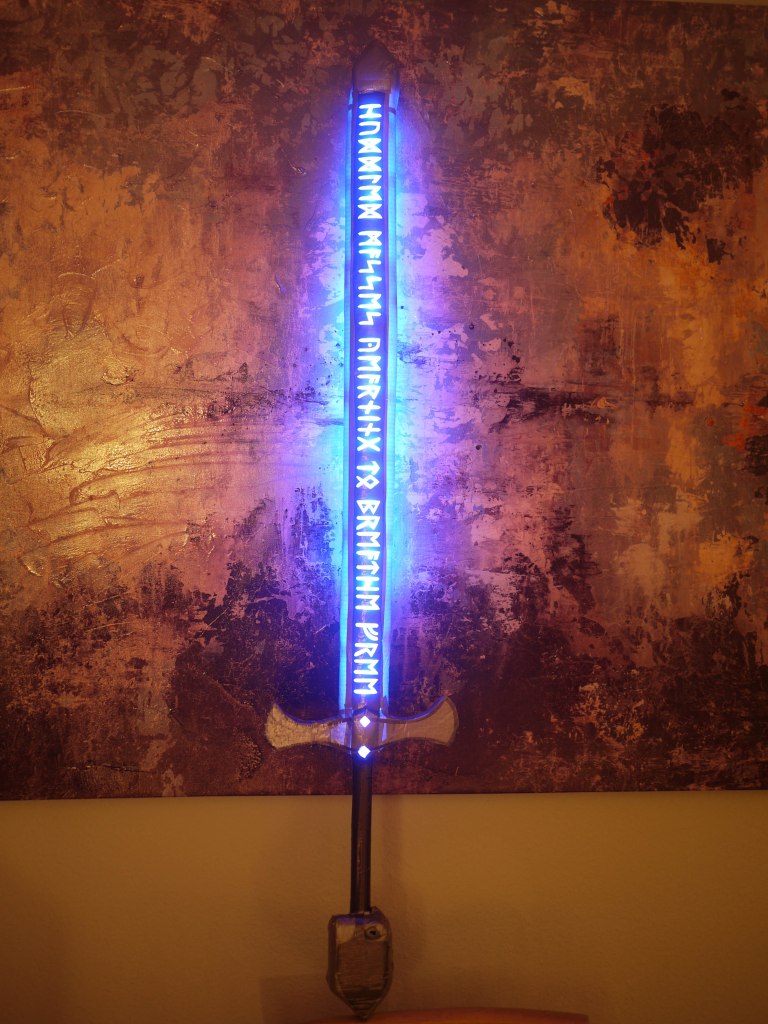
After crafting a variety of boffers, I eventually decided to check out how other people were doing it. Surprisingly few were using carbon fiber, which I believe is the optimal material. Much more common was fiberglass, which is heavier and less rigid.
I did come across a series by Odin Makes for cosplayers, and although his designs wouldn’t be as safe for LARPing, they did make me start pondering how to do electronics wizardry in a way that would be safe. (Most good creativity involves being exposed to a wide variety of other art and figuring out which bits you can re-imagine and re-shape to become something in your own style.)
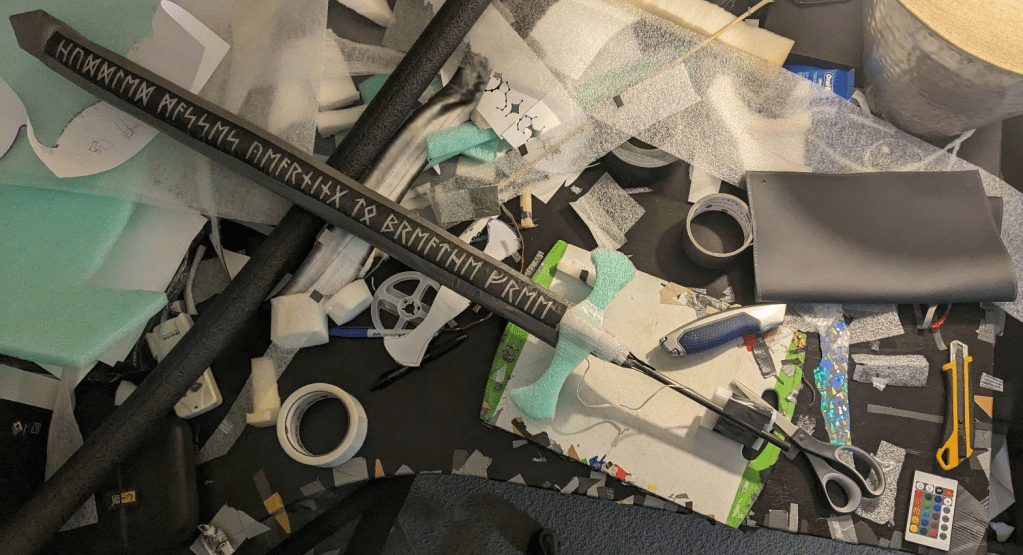
My terribly messy crafting desk. But hey, there are some Easter eggs of remnants from other projects if you look closely. Pro tip: Call the scattered remains of previous projects “Easter eggs.”
Sidebar: My concern about using Nordic runes to test the lighting rig idea is that such runes are often appropriated by bigots. So, I chose a phrase from the most famous pro-immigration poem I know, The New Colossus by Emma Lazarus, put it through a (obviously simplistic, but close enough) rune translator, and used that as the glowing pattern.

In this house we support love, liberty, immigration, and justice. The runes look cool, and the real ancient mythology is neat.
Against the 10mm-diameter carbon fiber tube core is a layer of closed-cell foam, and then a thin layer the packing foam, and on top of that is the LED strip, and then on top of that is more layers of the packing foam because it’s light but also very transparent, so it scatters the light without blocking it much. I had to do a series of testing to figure out how many layers would spread the light enough that you would see the light as a steady glow rather than a series of points from the LEDs.
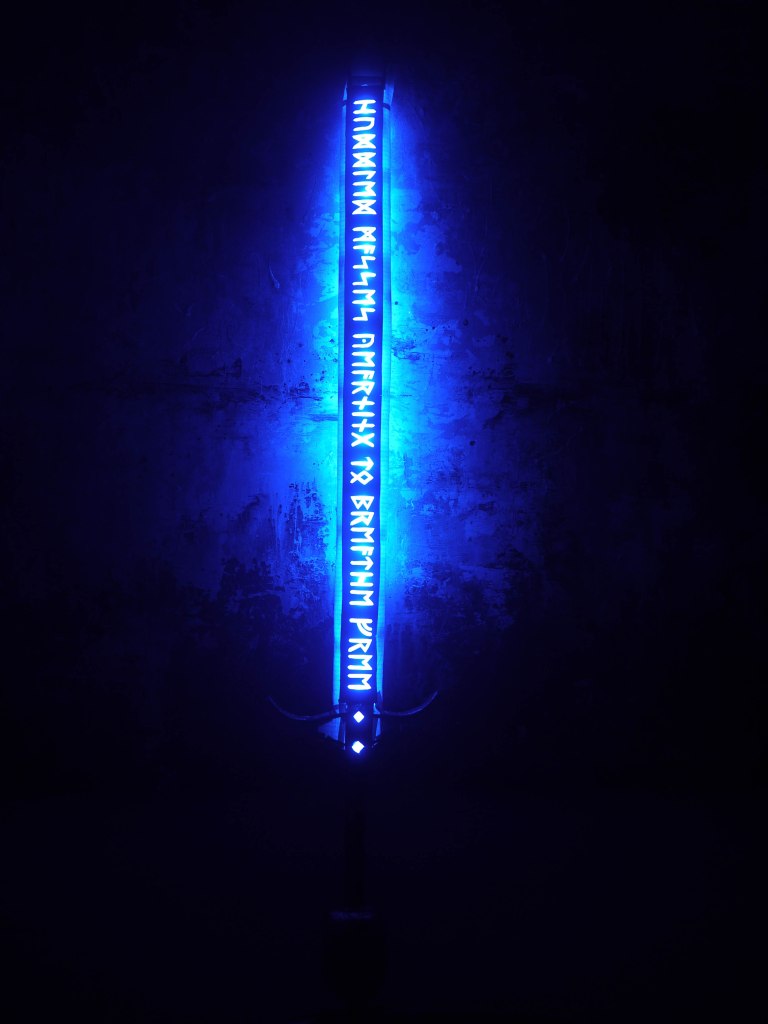
Indoors or when the sun has gone down, you can really see even the edges of the sword light up because I mostly used transparent duct tape to hold all the foam together internally so that the light would shine through the internals, and the runic parts are especially luminous since they’re directly up from the LEDs. The battery pack (3 AA batteries) is attached firmly to the core, and then the pommel is built around it (satisfying those who keep wanting me to add counterweights to boffers? We’ll see), with closed-cell foam all around it for padding, extra on the bottom, and a small hole so that the switch is accessible.
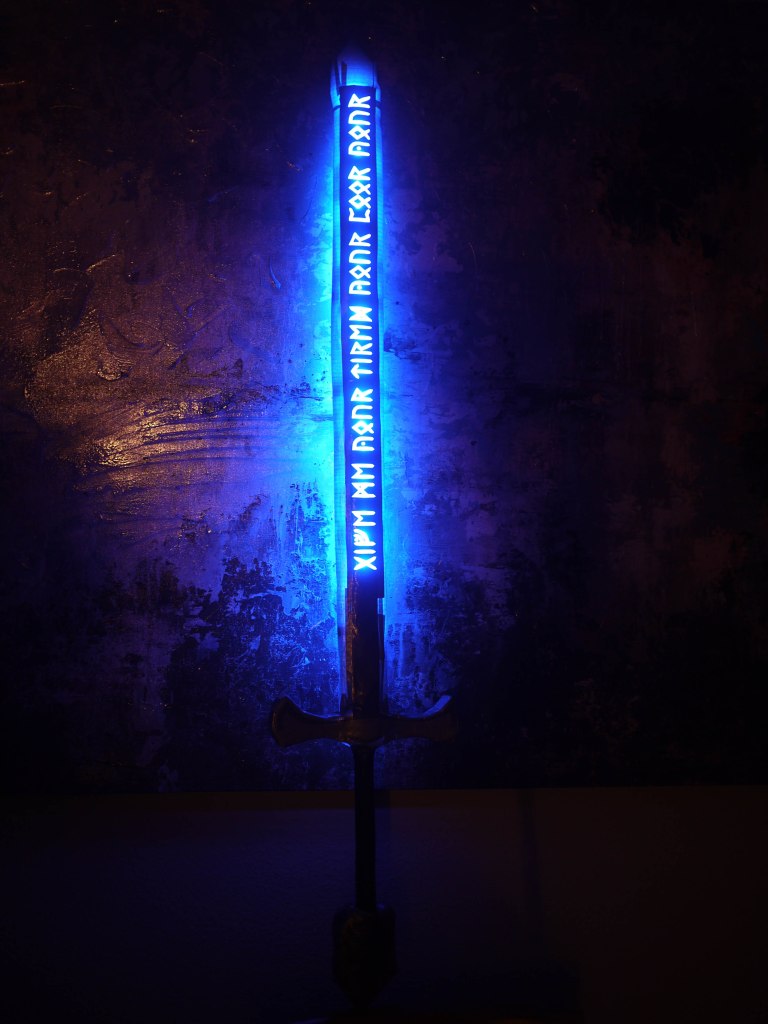
The edges of the blade, like all the rest of my composite foam designs, also include open-cell foam for additional padding, between the outer layer of closed-cell packing foam and the inner layer of closed-cell foam against the core, for significantly improved softness of the striking surface.
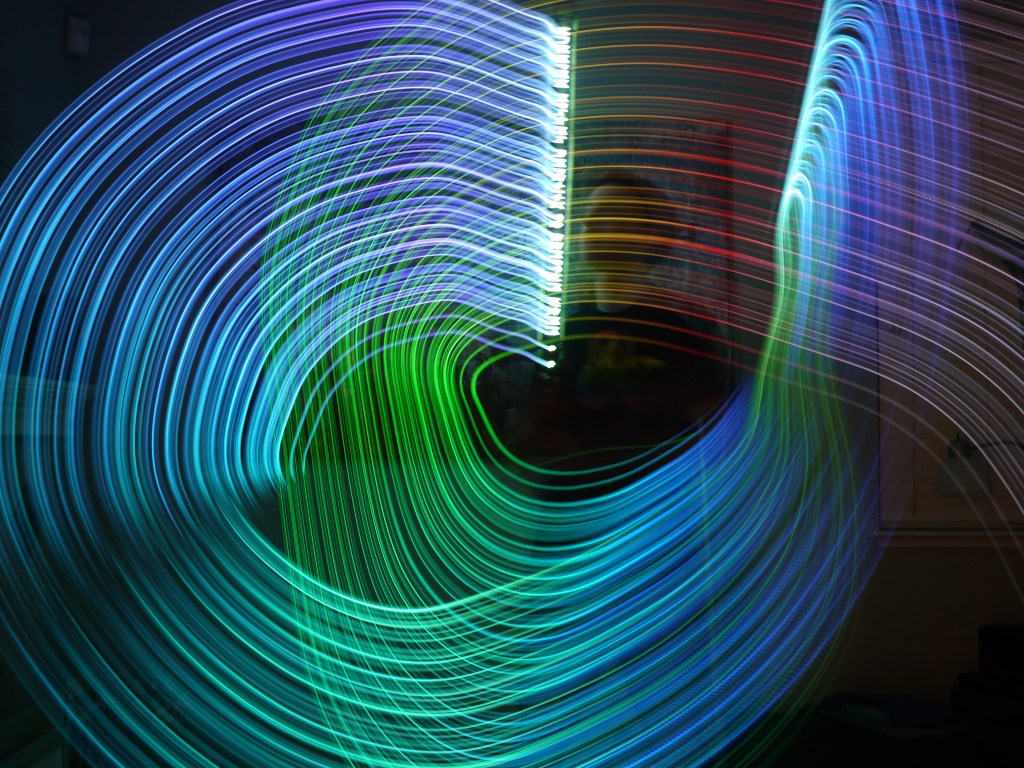
The LED strip can be set to fade between all its different colors, as well! I’m really pleased with how this long-exposure image turned out. You can see in the lower-left that I was successful in crafting the shape of the blade such that it has enough of a convex curve for runes to be visible from any angle, they’re just brighter from the direct side.



 Nico's Workshop