For a classic bardic character, I created this actually-playable lute that is also safe to bonk people with. It’s paired with a sword that has a guard in the shape of a golden treble clef and a line of sheet music twisting all along the blade.
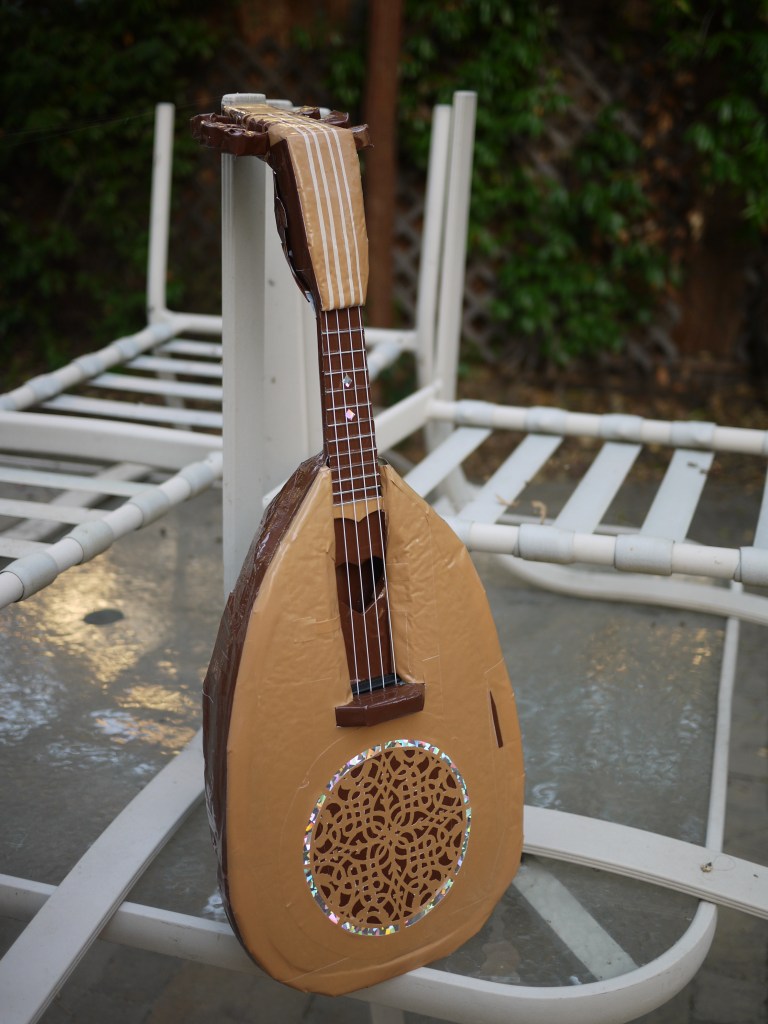
This is really an example of my “anything worth engineering is worth over-engineering” philosophy. At first I was just going to make a nonfunctional lute prop, but thought immediately that people would ask if it could play music, and would be mildly disappointed if it couldn’t. So, I ordered the cheapest child’s plastic ukulele I could find (both to save on cost and because I figured I wanted it to be as lightweight as possible), and built out the foam from there. The ukulele ends just below where the strings are visible, but the lute prop continues much farther, meaning there’s plenty of room for padding and empty space to make it nice and soft.
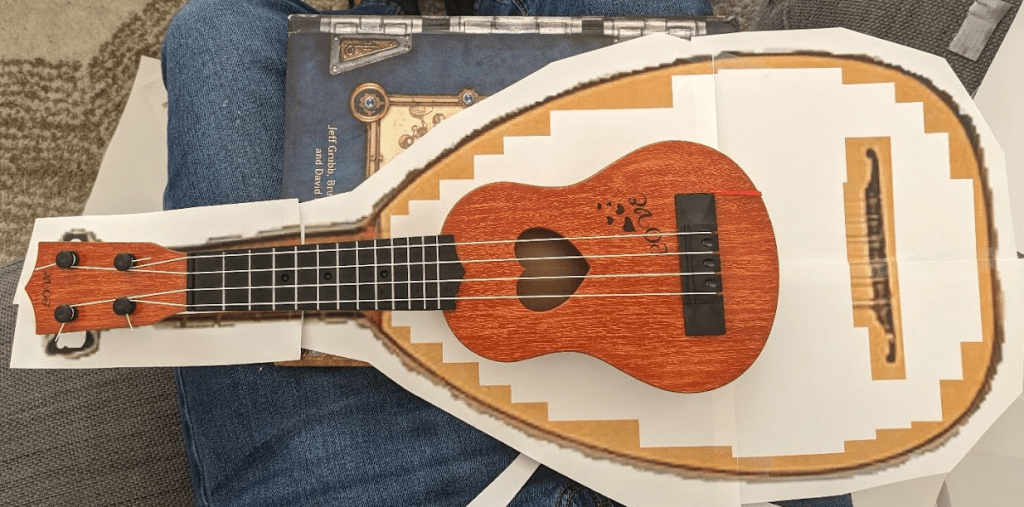
I added a decoy tuning board at the top of the prop to fit the shape of a proper medieval lute, while the actual tuning pegs are under a dark brown cover of duct tape that can be opened for tuning.
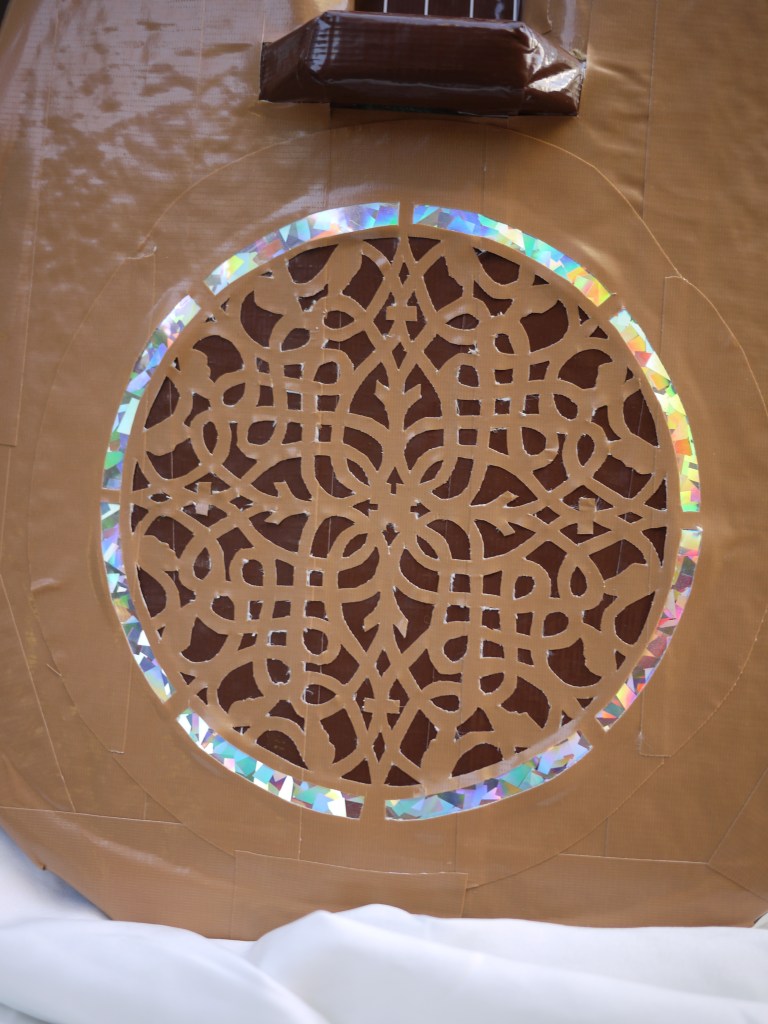
The decoration is based upon this design by Lutes & Guitars, but carved from two colors of duct tape. The surrounding opalescent circle is an addition of mine, using a sheet of reflective crystal-patterned plastics, inspired by the way many modern guitars have a mother-of-pearl circle. This is quite the undertaking — while I was in the middle of carving out the pattern, I messaged my sibling a picture with the caption “my hand hurts.”
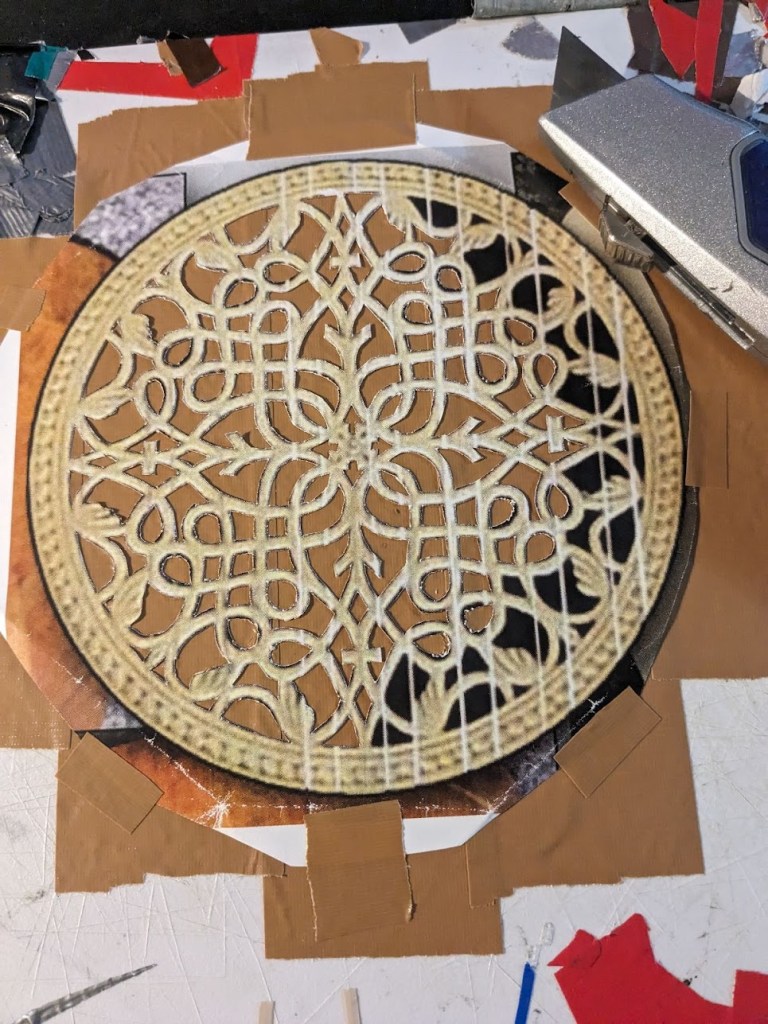
The level of precision required for all this is extremely high (even once you have the central design cut out, getting the crystalline external circle to line up exactly in all those cutouts, without also showing up in the central design, has a tolerance of maybe 2 millimeters around the entire ring), so I’m pleased it worked out so successfully! I modified the notches in the very center of the design to be arrows, in keeping with the four-dimensional symmetry theme of the LARP league it was designed for, merging into the weaving theme.

The sword that goes along with the lute, to complete the bard look, has a “cut time” symbol on the pommel, to amuse myself with a little visual pun. See the below images for a cross-section of the blade — the greener foam is closed-cell, the yellower foam is open-cell, and they’re both surrounded by a sleeve of closed-cell packing foam.


This design works because the core, being an 8mm-diameter carbon fiber tube, is so incredibly lightweight that this amount of foam is more than enough cushioning. The core plus the blade weighs a total of just 2.5 ounces. Most of the weight of the complete sword is in the handle.

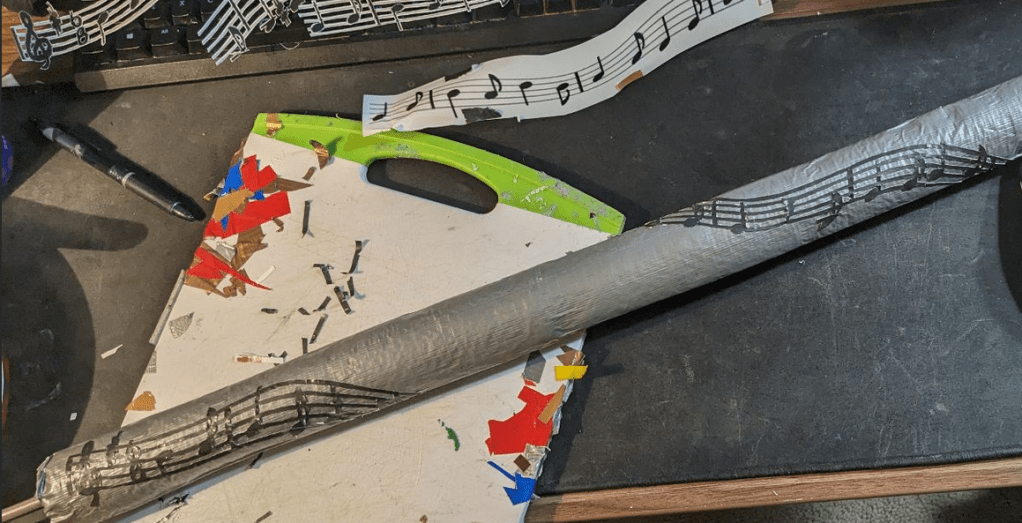
For the musical notes twisting along, I didn’t want to just use a straight line wrapped diagonally around the blade, since that would give it a simpler candy-cane look. Instead, I edited the the image of the line of music (I do all my editing work in GIMP 2, since it’s free and open-source) to curve and bounce so that it’s alternately readable along one side and then the other.

More exciting behind-the-scenes stuff: Transitioning from digital to physical by cutting the music in all-weather duct tape.
All in all, happy with how this set came out — perfect for a valorous image of a charismatic bard leaping around, telling daring tales and regaling allies with song within the tavern.

 Nico's Workshop